In the rapidly evolving digital landscape of 2026, search engine optimization (SEO) is no longer solely about keywords and backlinks. The advent of artificial intelligence (AI) has fundamentally transformed how WordPress websites achieve visibility and rank. As search engines like Google increasingly integrate AI into their core algorithms and introduce features like AI Overviews, leveraging the best AI SEO tools for WordPress (2026) has become an indispensable strategy for any digital presence.
This comprehensive guide delves into the cutting-edge AI SEO solutions available for WordPress users, examining how these intelligent tools streamline content creation, optimize technical elements, and provide predictive insights to keep your site ahead of the curve. Understanding and implementing these AI-powered strategies is crucial for maintaining relevance and achieving superior organic rankings in today’s competitive online environment.
Table of Contents
- Introduction: The Dawn of AI in WordPress SEO
- Understanding the AI SEO Landscape for WordPress
- Key Criteria for Choosing the Best AI SEO Tool for WordPress
- Top AI SEO Tools for WordPress (2026) – Detailed Reviews
- Integrating AI SEO Tools into Your WordPress Workflow
- The Future of AI in WordPress SEO: Trends for 2026 and Beyond
- Comparison Table: Key Features, AI Capabilities, and Pricing
- Frequently Asked Questions About AI SEO for WordPress
- Conclusion: Empower Your WordPress Site with Intelligent SEO
Introduction: The Dawn of AI in WordPress SEO
The year 2026 marks a significant inflection point in the history of SEO, driven overwhelmingly by advancements in artificial intelligence. For WordPress website owners, this means a shift from manual, reactive optimization tactics to proactive, intelligent strategies powered by AI. AI SEO tools are not merely automation platforms; they are sophisticated systems that analyze vast datasets, understand semantic relationships, and predict search trends with unprecedented accuracy.
AI is reshaping search engine optimization by offering capabilities that far exceed traditional methods. From generating highly optimized content that resonates with user intent and satisfies E-E-A-T (Experience, Expertise, Authoritativeness, Trustworthiness) guidelines, to performing intricate technical audits and identifying untapped keyword opportunities, AI is making SEO more efficient, effective, and accessible. The integration of Large Language Models (LLMs) into SEO workflows, in particular, has revolutionized content creation and optimization, allowing for the production of high-quality, semantically rich articles at scale. This evolution is vital for WordPress sites aiming to capture prime positions in both traditional search results and the increasingly prominent Google AI Overviews.
Understanding the AI SEO Landscape for WordPress
The AI SEO landscape for WordPress is characterized by a dynamic interplay of advanced algorithms, machine learning, and natural language processing, all designed to enhance a website’s visibility and authority. This segment explores the core distinctions between AI-driven and traditional SEO, the rapid evolution of AI in search, and its critical role for WordPress users in the era of AI Overviews.
What Exactly is AI SEO and How Does it Differ from Traditional SEO?
AI SEO refers to the application of artificial intelligence and machine learning technologies to automate, optimize, and enhance various aspects of search engine optimization. Unlike traditional SEO, which often relies on manual research, reactive adjustments, and rule-based optimizations, AI SEO leverages data-driven insights and predictive analytics to inform strategy.
- Traditional SEO: This involves manual keyword research, content creation based on general best practices, reactive backlink building, periodic technical audits, and adjustments after algorithm updates.
- AI SEO: This paradigm shift integrates automated keyword discovery (including semantic and long-tail phrases), AI-generated or enhanced content, predictive analytics for trend forecasting, real-time technical monitoring, proactive adaptation to algorithm shifts, sophisticated competitor analysis, and optimization for conversational search queries.
The fundamental difference lies in AI’s capacity to process and interpret complex data patterns at a scale impossible for humans, leading to more precise, effective, and future-proof SEO strategies. AI tools can identify nuanced relationships between content, user intent, and ranking factors, providing actionable recommendations that go beyond simple keyword density.
The Evolution of AI in SEO: From Automation to Autonomy and LLM Integration
The journey of AI in SEO has progressed significantly. Initially, AI applications focused on basic automation—tasks like scheduling social media posts or simple data scraping. The next phase saw more sophisticated automation, such as automated reporting and basic content analysis.
Today, in 2026, AI has moved towards greater autonomy and intelligence, largely driven by the advancement of Large Language Models (LLMs). These models, often built on sophisticated neural networks and transformer architectures, like those powering Google’s Bard or OpenAI’s GPT series, can understand, generate, and summarize human-like text, profoundly impacting content creation, topic clustering, and semantic optimization. LLM integration allows AI SEO tools to:
- Generate entire articles or sections based on specific SEO briefs, ensuring topical authority.
- Rewrite and refine existing content for improved readability, E-E-A-T, and keyword relevance.
- Perform deep semantic analysis to identify topical gaps and entity relationships.
- Automate schema markup generation, enhancing structured data implementation.
- Provide advanced recommendations for internal linking and content hierarchy.
This evolution means AI tools are no longer just assistants; they are integral strategic partners in SEO.
Why WordPress Users Need AI SEO Tools More Than Ever in 2026
WordPress powers over 43% of all websites, making it a prime target for SEO competition. In 2026, the sheer volume of content being produced and the sophistication of search engine algorithms necessitate AI assistance for WordPress users. Without AI SEO tools, sites risk falling behind in several critical areas:
- Content Velocity: AI enables the rapid production of high-quality, optimized content to keep pace with market demands. For example, a marketing team manually tracking 50 keywords across 10 different pages might miss emerging trends; AI instantly identifies keyword decay and suggests new variations, allowing rapid content adaptation.
- Competitive Edge: Leading SEO analysts predict that businesses failing to adopt AI in their SEO strategies by 2026 will face significant disadvantages as competitors leverage these tools for superior performance.
- Algorithm Complexity: Modern search algorithms are complex, incorporating factors like user intent, semantic relevance, and E-E-A-T. AI tools can analyze and adapt to these complexities more effectively than manual efforts.
- Resource Optimization: AI automates time-consuming tasks, freeing up human SEO specialists to focus on high-level strategy and creative initiatives, such as building unique brand narratives or conducting in-depth competitive analysis.
- Accuracy and Precision: AI reduces human error in data analysis and provides more precise recommendations for optimization, ensuring every SEO effort is maximally effective.
For any WordPress site aiming for sustainable growth and top rankings, AI SEO tools are no longer a luxury but a fundamental requirement.
Navigating Google’s AI Overviews with Intelligent SEO Solutions
Google’s AI Overviews, which provide AI-generated summaries at the top of the Search Engine Results Pages (SERPs), represent a monumental shift in how users consume information. For WordPress sites, optimizing for AI Overviews means ensuring your content is:
- Highly Factual and Authoritative: AI Overviews prioritize verifiable, trustworthy information, drawing from sources demonstrating clear E-E-A-T.
- Structured and Extractable: Content needs to be easily digestible and quotable by AI systems, often requiring clear headings, bullet points, and concise answer blocks.
- Semantically Rich: AI Overviews draw from a deep understanding of topics and entities, not just keywords. An ‘entity’ in this context is a distinct object or concept, like ‘Eiffel Tower’ or ‘Artificial Intelligence,’ and AI tools help ensure comprehensive entity coverage.
- Answer-Focused: Directly answer common questions clearly and concisely within your content, using an ‘answer-first’ structure.
AI SEO tools specifically help WordPress users prepare for AI Overviews by: identifying key questions users are asking, structuring content for maximum extractability, ensuring topical completeness, and verifying factual accuracy against authoritative sources. According to industry standards, content optimized for AI Overviews must demonstrate clear Experience, Expertise, Authoritativeness, and Trustworthiness (E-E-A-T), which AI tools can assist in auditing and enhancing.
Key Criteria for Choosing the Best AI SEO Tool for WordPress
Selecting the optimal AI SEO tool for your WordPress site in 2026 requires careful consideration of several critical factors. The right tool should not only integrate seamlessly with WordPress but also offer advanced AI capabilities that align with modern SEO demands.
LLM Integration and Advanced Content Generation Capabilities
The ability of an AI SEO tool to leverage Large Language Models (LLMs) is paramount in 2026. This goes beyond simple content rephrasing; it involves generating original, high-quality, and semantically rich content that is optimized for both human readers and search engine algorithms. Look for tools that can:
- Generate full articles, blog posts, or sections based on a specific topic and target keywords.
- Craft compelling headlines, meta descriptions, and introductions that capture user interest.
- Assist with outlining content structures and identifying key subtopics, ensuring comprehensive coverage.
- Ensure content adheres to E-E-A-T principles by incorporating relevant entities and factual accuracy checks.
- Adapt content tone and style to match your brand voice, maintaining consistency across your digital presence.
Real-time SERP Analysis and Predictive SEO Analytics
Effective AI SEO tools provide more than just historical data; they offer real-time insights and predictive capabilities. This includes:
- Live SERP Analysis: Understanding current ranking factors, competitor strategies, and content gaps directly from the search results.
- Predictive Keyword Research: Identifying emerging trends and future keyword opportunities before they become saturated, giving you a competitive edge.
- Performance Forecasting: Estimating the impact of SEO changes on rankings and traffic, allowing for data-backed decision-making.
- Algorithm Change Detection: Alerting users to potential impacts of Google algorithm updates and suggesting immediate adjustments, minimizing negative effects.
Comprehensive On-Page Optimization and Technical SEO Automation
While content generation is crucial, a holistic AI SEO tool must also excel in on-page and technical SEO. This involves:
- On-Page Content Scoring: Providing real-time feedback on content quality, readability, keyword usage, and semantic relevance within the WordPress editor.
- Schema Markup Automation: Automatically generating and implementing structured data (e.g., Article, FAQ, Product schema) to enhance visibility in rich results and AI Overviews.
- Internal Linking Suggestions: Recommending relevant internal links to improve site structure, pass link equity, and enhance user navigation.
- Technical Audit & Fixes: Identifying and suggesting automated solutions for common technical SEO issues like broken links, crawl errors, site speed optimizations, and mobile-friendliness.
User Experience (UX) and E-E-A-T Signals Integration
Google’s emphasis on user experience and E-E-A-T continues to grow. An advanced AI SEO tool should help you optimize for these human-centric factors:
- Readability and Engagement Metrics: Analyzing content for clarity, flow, and potential for user engagement, ensuring your audience stays on your page longer.
- Sentiment Analysis: Understanding the emotional tone of your content and how it aligns with user intent, helping to create more persuasive or informative pieces.
- Authority Signals: Helping to identify opportunities to showcase expertise, such as optimizing author bios, suggesting relevant citations, and integrating external references.
- Core Web Vitals Monitoring: Integrating with WordPress to monitor and provide suggestions for improving page load speed, interactivity, and visual stability, directly impacting user satisfaction.
Seamless WordPress Compatibility and Ease of Use
For WordPress users, the tool must integrate effortlessly into the existing ecosystem. Key considerations include:
- Plugin Integration: A dedicated WordPress plugin that works harmoniously with other essential plugins and themes, avoiding conflicts.
- Intuitive Interface: A user-friendly dashboard that doesn’t require extensive technical knowledge, making advanced SEO accessible to all skill levels.
- Customization Options: Flexibility to tailor settings and recommendations to specific website needs, ensuring the tool adapts to your unique strategy.
- Performance Impact: Ensuring the plugin does not negatively affect site speed or performance, which is a critical ranking factor.
Cost-Effectiveness, Scalability, and Support
Finally, evaluate the tool’s pricing model, its ability to scale with your website’s growth, and the quality of customer support:
- Pricing Tiers: Look for plans that match your current needs and offer room for expansion as your website grows.
- Scalability: Can the tool handle multiple websites, large content volumes, or growing traffic without performance degradation?
- Documentation and Support: Comprehensive guides, tutorials, and responsive customer service are essential for effective implementation and troubleshooting.
Top AI SEO Tools for WordPress (2026) – Detailed Reviews
The market for AI SEO tools for WordPress has matured significantly by 2026, offering a diverse range of solutions. Here, we provide detailed reviews of the leading platforms, highlighting their unique AI capabilities and how they empower WordPress users to achieve superior rankings.
AIRAG SEO Agent: Our Top Pick for AI-Powered Content Generation and Ranking
The AIRAG SEO Agent stands out as a premier AI SEO solution, specifically engineered to generate SEO blogs that rank effectively in both traditional search engines and advanced AI results. Developed by ShahiSoft, this tool leverages cutting-edge LLMs and proprietary AI algorithms to transform content creation into a strategic advantage for WordPress sites. It is designed for businesses and content creators who demand high-quality, relevant, and search-optimized content at scale.
Key AI Capabilities:
- Advanced Content Generation: AIRAG SEO Agent excels at producing comprehensive, well-structured blog posts from a prompt, complete with optimized headings, engaging paragraphs, and natural keyword integration. It focuses on semantic relevance and topical authority, crucial for modern SEO.
- AI-Driven Ranking Optimization: Unlike generic AI writers, AIRAG SEO Agent is built with ranking in mind. It analyzes SERP data, identifies content gaps, and tailors its output to meet Google’s evolving E-E-A-T standards, making content more likely to be featured in AI Overviews.
- Semantic Entity Coverage: The tool ensures that generated content covers all relevant entities and subtopics, providing a holistic understanding of the subject matter, which is vital for deep topical authority.
- WordPress Native Integration: As a dedicated WordPress plugin, it offers a seamless workflow, allowing users to generate and publish optimized content directly within their WordPress dashboard.
- Targeted for AI Results: It specifically optimizes content for extractability by AI systems, using clear definitions, bullet points, and answer-first structures, making it ideal for AI Overviews and conversational search.
Who is AIRAG SEO Agent Best For? WordPress users prioritizing high-volume, high-quality, and highly optimized content generation directly within their CMS, particularly those aiming for strong performance in AI-driven search results.
Expert Insight: Experienced content strategists recognize that raw AI output often lacks the nuanced understanding of search intent. AIRAG SEO Agent’s strength lies in its specialized training to align generated content with specific ranking signals, making it a more ‘SEO-aware’ AI writing solution compared to general-purpose LLMs.
Rank Math: Advanced AI for Comprehensive WordPress SEO
Rank Math has established itself as a robust, feature-rich WordPress SEO plugin, and by 2026, its AI capabilities have significantly expanded. It aims to be an all-in-one solution, providing tools for on-page SEO, technical SEO, local SEO, and more, now with intelligent assistance.
Key AI Capabilities:
- AI Content AI: Rank Math’s Content AI module leverages natural language processing to provide real-time suggestions for content optimization. It analyzes top-ranking content for target keywords, recommending optimal keyword density, related keywords, questions to answer, and ideal word count to achieve higher rankings.
- Schema Markup Automation: The plugin intelligently suggests and automates the creation of various schema types, ensuring your WordPress content is well-structured for rich snippets and AI Overviews.
- Predictive Keyword Suggestions: Beyond basic keyword research, Rank Math uses AI to suggest long-tail and semantically related keywords, helping users uncover new content opportunities.
- Intelligent Internal Linking: It analyzes your content and suggests relevant internal links, improving site architecture and distributing link equity effectively.
- SEO Analysis and Audits: AI-powered audits identify technical SEO issues, performance bottlenecks, and on-page optimization gaps, providing actionable recommendations for improvement.
Who is Rank Math Best For? WordPress users seeking a powerful, integrated SEO solution that incorporates AI to streamline complex tasks, suitable for both beginners and advanced SEO professionals managing multiple aspects of their site’s SEO from one dashboard.
Considerations for Rank Math Users: Its extensive feature set can have a steeper learning curve for absolute beginners, requiring time to master all capabilities.
Yoast SEO: Enhancing Content with AI-Driven Readability and SEO Suggestions
Yoast SEO remains a cornerstone of WordPress SEO, and its evolution in 2026 includes enhanced AI capabilities focused on content quality and user experience. While traditionally strong in readability and basic SEO, its AI integration now provides more sophisticated analysis.
Key AI Capabilities:
- Advanced Readability Analysis: Yoast SEO leverages NLP to provide deeper insights into content readability, going beyond Flesch-Kincaid scores. It identifies complex sentences, passive voice, and suggests improvements for better user engagement and AI extractability.
- Semantic Keyword Integration: Its AI helps users naturally integrate primary and secondary keywords, ensuring content is semantically rich without keyword stuffing. It also suggests related key phrases based on topical analysis.
- Internal Linking Suggestions: Yoast’s AI-powered feature suggests relevant existing posts on your WordPress site for internal linking, aiding in content hub creation and improving site structure.
- Content Insights: It provides feedback on the overall quality and comprehensiveness of your content, comparing it against known best practices for E-E-A-T and topical coverage.
- AI for Schema Markup: While not fully autonomous, Yoast assists in generating correct schema markup for various content types, improving chances for rich results.
Who is Yoast SEO Best For? WordPress users who prioritize content quality, readability, and a structured approach to on-page SEO, especially those focused on creating authoritative, easy-to-digest information that performs well in AI Overviews.
Considerations for Yoast SEO Users: While robust for on-page and readability, its content generation capabilities are less extensive compared to dedicated AI writing tools.
Surfer SEO: Data-Driven Content Optimization with AI Insights
Surfer SEO is renowned for its data-driven approach to content optimization, and its AI capabilities have become even more central to its offering by 2026. It focuses on analyzing top-ranking content to provide precise, actionable recommendations for creating content that outranks competitors.
Key AI Capabilities:
- Content Editor with AI: Surfer’s core feature, the Content Editor, uses AI and NLP to analyze hundreds of ranking factors for your target keyword. It provides real-time scores and suggestions for word count, relevant keywords, headings, images, and structure, all based on what’s currently performing best.
- Keyword Research & Clustering: AI-powered keyword research helps discover content gaps and automatically groups related keywords into clusters, facilitating the creation of comprehensive topic hubs.
- Audit Tool: Its audit feature uses AI to compare your existing content against top performers, highlighting areas for improvement in terms of missing keywords, content structure, and on-page elements.
- AI Outline Builder: Surfer can generate content outlines based on SERP analysis, including suggested headings and questions to answer, streamlining the content creation process.
- Generative AI Integration: By 2026, Surfer SEO integrates generative AI to help users draft sections of content or expand on ideas directly within the Content Editor, ensuring the generated text aligns with its data-driven recommendations.
Who is Surfer SEO Best For? WordPress users who are serious about data-backed content optimization and want to ensure every piece of content is built to rank. It’s powerful for content strategists, SEO writers, and agencies focused on competitive niches.
Considerations for Surfer SEO Users: It functions primarily as an external tool, requiring manual copy-pasting or API connections for full integration with the WordPress content management system, which might not be as seamless as native plugins.
BlogSEO.io: Streamlining AI Content Creation for WordPress
BlogSEO.io has emerged as a specialized AI tool focusing heavily on content generation and optimization specifically for blog posts, a critical component for many WordPress sites. It aims to simplify the process of creating high-ranking blog content with AI assistance.
Key AI Capabilities:
- Full Blog Post Generation: BlogSEO.io can generate complete, SEO-optimized blog posts from a single keyword or topic. Its AI is trained to produce engaging and informative content that addresses user intent.
- Outline & Heading Generation: The tool automatically creates structured outlines and suggests optimized headings (H1, H2, H3) to improve content flow and search engine crawlability.
- Keyword and Semantic Integration: It uses AI to identify and naturally weave in primary, secondary, and LSI (Latent Semantic Indexing) keywords throughout the content, boosting topical relevance.
- Content Brief Creation: BlogSEO.io can analyze SERPs and generate detailed content briefs, including word count targets, critical topics to cover, and questions to answer, guiding human writers or further AI generation.
- Readability and Tone Adjustments: Its AI helps ensure content is not only SEO-friendly but also highly readable and aligned with a desired brand tone, improving user experience.
Who is BlogSEO.io Best For? WordPress users whose primary SEO strategy revolves around blogging. It’s particularly beneficial for small businesses, solopreneurs, and content teams looking to scale their blog content production efficiently.
Considerations for BlogSEO.io Users: While excellent for content generation, its technical SEO features are less comprehensive than all-in-one plugins, potentially requiring complementary tools.
SEOPress: AI-Powered Audits and Performance Monitoring
SEOPress is another comprehensive WordPress SEO plugin that has integrated AI to enhance its auditing and monitoring capabilities. While offering a wide range of traditional SEO features, its AI focuses on analysis and actionable insights.
Key AI Capabilities:
- AI-Driven SEO Audits: SEOPress leverages AI to perform in-depth SEO audits of your WordPress site, identifying critical issues related to technical SEO, on-page optimization, and content quality. It provides prioritized recommendations for improvement.
- Content Analysis & Suggestions: Its AI analyzes your content for keyword usage, readability, and semantic relevance, offering real-time suggestions within the WordPress editor to optimize posts and pages.
- Broken Link Detection with AI: The tool intelligently scans for broken links (internal and external) and suggests fixes, improving user experience and crawlability.
- Performance Monitoring: AI assists in monitoring key performance indicators (KPIs) and alerting users to significant changes in rankings, traffic, or technical health.
- Schema Markup Assistance: While not fully automated, SEOPress uses AI to guide users through the process of adding various schema types, ensuring correct implementation.
Who is SEOPress Best For? WordPress users who need a powerful, all-in-one SEO solution with a strong emphasis on site health, auditing, and performance monitoring, particularly those managing the SEO of multiple sites.
Considerations for SEOPress Users: Its AI features are more geared towards analysis and recommendations rather than direct content generation, which might necessitate another tool for content creation at scale.
AIOSEO: The All-in-One AI SEO Solution for WordPress
AIOSEO (All in One SEO Pack) has been a long-standing player in the WordPress SEO plugin market, and by 2026, it has significantly bolstered its offerings with integrated AI features. It aims to provide a comprehensive, user-friendly SEO solution for all types of WordPress sites, from small blogs to e-commerce stores.
Key AI Capabilities:
- TruSEO Score with AI: AIOSEO’s TruSEO Score provides real-time analysis and recommendations for optimizing your content. Its AI engine evaluates readability, keyword usage, internal linking, and content structure, offering actionable insights to improve your score.
- Smart Schema Markup: The plugin uses AI to automatically detect content types and suggest appropriate schema markup, helping your WordPress site appear in rich snippets and AI Overviews.
- AI-Powered Link Assistant: AIOSEO’s Link Assistant scans your site and intelligently suggests relevant internal links, improving site navigation, SEO, and user experience.
- Advanced Keyword Research: Its integrated keyword research tools leverage AI to uncover hidden keyword opportunities, analyze competitor rankings, and identify long-tail keywords that drive targeted traffic.
- Content Analysis and Optimization: AI helps users identify content gaps, optimize for semantic relevance, and ensure their content aligns with user intent, crucial for E-E-A-T.
Who is AIOSEO Best For? WordPress users who desire a complete, user-friendly AI SEO toolkit without needing multiple plugins. It’s suitable for beginners and experienced marketers alike, offering a streamlined approach to managing all aspects of SEO directly within WordPress.
Considerations for AIOSEO Users: While comprehensive, some advanced AI content generation features might not be as deeply integrated or specialized as those found in dedicated AI writing platforms.
Integrating AI SEO Tools into Your WordPress Workflow
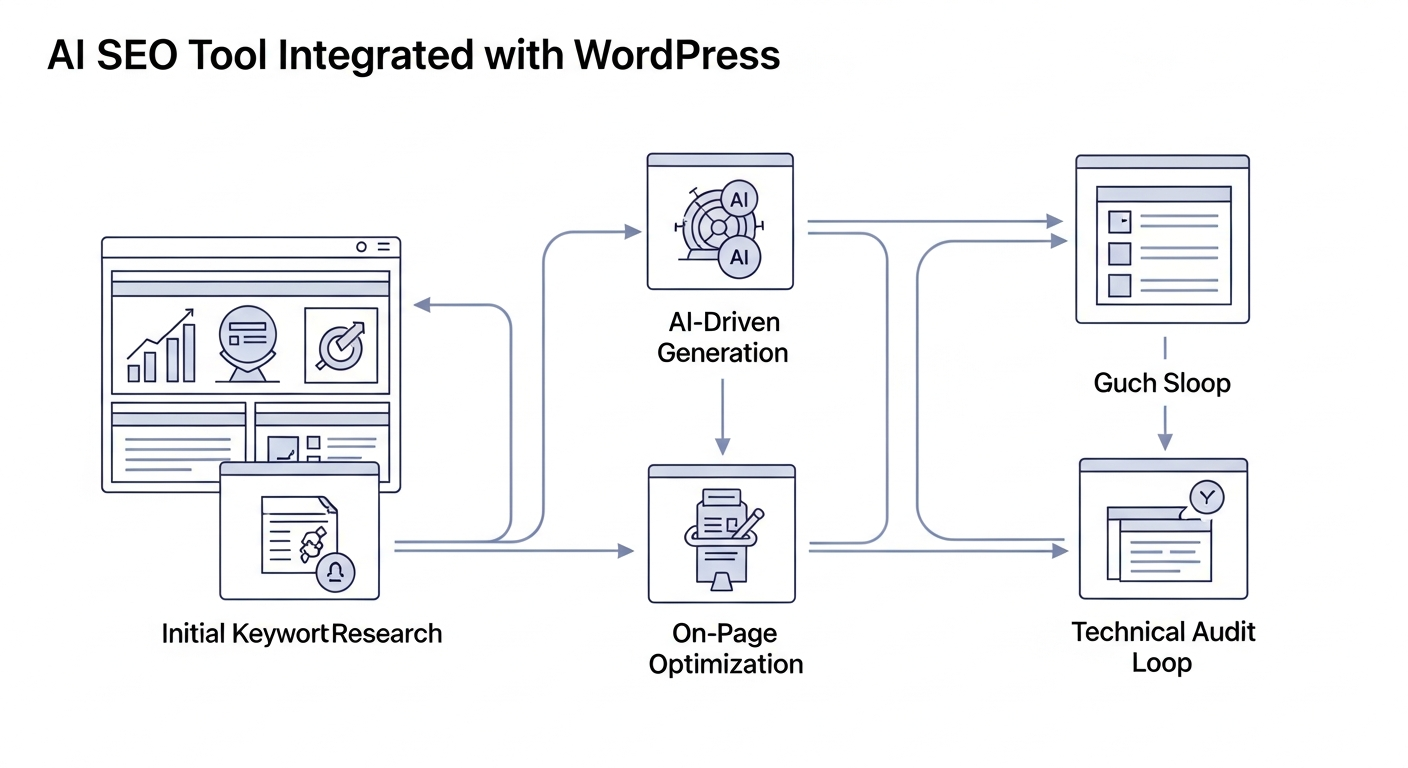
Successfully integrating AI SEO tools into your WordPress workflow is key to unlocking their full potential. It requires a strategic approach that combines automation with human oversight to ensure optimal results and maintain content quality.
Best Practices for Seamless Implementation and Maximizing Efficiency
To get the most out of your AI SEO tools on WordPress, consider these best practices:
- Start with a Clear Strategy: Define your SEO goals (e.g., increased organic traffic, higher rankings for specific keywords, better content velocity) before implementing any tool.
- Phased Implementation: Don’t try to automate everything at once. Start by integrating AI into one or two core areas, like keyword research or content outlining, and gradually expand.
- Human Oversight is Crucial: While AI automates, human review, editing, and strategic direction remain indispensable. AI-generated content still needs a human touch for brand voice, factual accuracy, and creative flair.
- Regular Monitoring and Adjustment: Continuously monitor the performance of your AI-driven optimizations. Use analytics to identify what’s working and what needs refinement.
- Train Your AI (Where Applicable): Some advanced AI tools allow for customization and training. Feed them specific brand guidelines, preferred terminology, and successful content examples to improve output quality.
- Leverage Integrations: Many AI SEO tools integrate with other WordPress plugins or external platforms. Utilize these connections to create a cohesive and efficient ecosystem.
A key strategy to consider is using AI for initial drafts and data analysis, then having human experts refine and add unique insights. This ensures the E-E-A-T of your content remains paramount, blending AI’s speed with human experience and judgment. For instance, an AI tool might generate a compelling outline, but an experienced writer adds personal anecdotes or unique case studies that truly resonate with an audience.
Common Mistakes to Avoid When Using AI for WordPress SEO
While AI offers immense benefits, there are pitfalls to avoid:
- Over-Reliance on AI for Content Quality: Expecting AI to produce perfect, publish-ready content without human editing can lead to generic, inaccurate, or poorly researched articles that fail to rank or engage.
- Ignoring Search Intent: AI might generate content based on keywords, but it’s up to the human operator to ensure the content truly addresses the underlying search intent of the user.
- Neglecting E-E-A-T: AI-generated content, if not properly reviewed and augmented with real-world experience and authoritative sources, can lack the crucial E-E-A-T signals that Google values.
- Keyword Stuffing (Even with AI): While AI helps with keyword integration, misuse can still lead to over-optimization, which search engines can penalize.
- Ignoring Technical SEO Fundamentals: AI tools can assist, but they don’t replace the need for a solid understanding of core technical SEO principles.
- Forgetting About User Experience: Content generated by AI should still be formatted for readability, accessibility, and overall positive user experience.
Automating SEO Tasks: From Keyword Research to Content Publishing
AI SEO tools can automate a wide array of tasks within your WordPress workflow:
- Keyword Research: AI can rapidly analyze vast datasets to identify high-potential keywords, semantic variations, and content gaps that human researchers might miss. For example, an AI tool can process millions of search queries to uncover long-tail opportunities that manual methods would take weeks to find.
- Content Outlining: Generating comprehensive content outlines, including suggested headings and subtopics, based on competitor analysis and search intent.
- Content Drafting: Creating initial drafts of articles, product descriptions, meta descriptions, and social media updates, significantly reducing the time to first draft.
- On-Page Optimization: Providing real-time suggestions within the WordPress editor for keyword usage, readability, internal linking, and schema markup.
- Technical Audits: Automatically scanning your WordPress site for technical issues like broken links, crawl errors, and performance bottlenecks, then suggesting fixes.
- Performance Monitoring: Tracking rankings, traffic, and other key metrics, and alerting you to significant changes or opportunities.
By automating these tasks, AI frees up valuable time for strategic planning, creative development, and high-impact initiatives, allowing WordPress users to achieve more with fewer resources.
The Future of AI in WordPress SEO: Trends for 2026 and Beyond
The landscape of AI in WordPress SEO is continually evolving, with several key trends shaping its future. Understanding these developments is essential for staying ahead and future-proofing your digital strategy.
Predictive SEO and Proactive Optimization Strategies
The future of AI in SEO lies increasingly in predictive analytics. Instead of reacting to algorithm changes or drops in rankings, AI will enable WordPress sites to proactively optimize for future trends. This involves:
- Anticipating Algorithm Shifts: AI models will analyze historical data and industry signals to predict potential Google algorithm updates, allowing for pre-emptive adjustments. Research from major search engine conferences indicates a growing focus on predictive modeling to maintain organic visibility.
- Forecasting Content Demand: Predictive AI will identify emerging topics and user interests before they become mainstream, giving content creators a significant head start. For example, an AI might detect a nascent trend in ‘sustainable AI solutions for small businesses’ months before it peaks in search volume.
- Proactive Technical Maintenance: AI systems will monitor site health and user behavior patterns to identify potential technical issues before they impact rankings, such as predicting server load issues or impending crawl budget problems.
This shift from reactive to proactive optimization will be a game-changer for WordPress users, enabling them to maintain consistent visibility and growth.
Hyper-Personalization and the Evolution of Semantic Search
AI will drive an unprecedented level of personalization in search results. Semantic search, which focuses on the meaning and context of queries rather than just keywords, will become even more sophisticated. For WordPress sites, this means:
- Entity-Based SEO: Optimizing content around specific entities (people, places, concepts, or organizations) and their relationships, rather than just keywords, to align with how AI understands information.
- Personalized Content Delivery: AI will help tailor content experiences based on individual user behavior, location, and search history, making content more relevant and engaging.
- Deep Intent Understanding: AI will enable a more profound understanding of complex user intent, allowing WordPress sites to create content that precisely answers nuanced queries, moving beyond simple keyword matching.
The Role of AI in Adapting to Google’s Evolving Algorithms
Google’s algorithms are becoming increasingly AI-driven, with systems like RankBrain, BERT, and MUM playing significant roles. In 2026 and beyond, AI SEO tools will be crucial for adapting to these changes by:
- Real-time Algorithm Analysis: AI will continuously monitor Google’s ranking signals and update optimization recommendations in real-time, providing agile responses to algorithm shifts.
- E-E-A-T Enhancement: AI will become more adept at identifying and suggesting ways to strengthen a site’s Experience, Expertise, Authoritativeness, and Trustworthiness signals, which are critical for ranking, such as recommending specific external citations or author profile optimizations.
- Content Quality Assessment: AI will help ensure content meets Google’s ever-higher standards for quality, originality, and helpfulness, reducing the risk of penalties by flagging potentially low-value or duplicate content.
Voice Search, Multimodal AI, and Conversational SEO
The rise of voice assistants and multimodal search (combining text, image, and voice queries) will further shape AI SEO. WordPress sites will need to optimize for:
- Conversational Queries: AI tools will help identify and optimize for natural language questions, which are prevalent in voice search, by understanding intent and providing concise answers.
- Multimodal Content: Creating content that is optimized for various input types, such as detailed image alt text for visual search or structured data for quick answers in voice results.
- Contextual Understanding: AI will assist in understanding the broader context of user queries across different modalities, enabling more relevant content delivery regardless of how the user searches.
These trends highlight that AI is not just a tool for optimization but a fundamental shift in how SEO is conceived and executed, especially for WordPress platforms.
Comparison Table: Key Features, AI Capabilities, and Pricing of Top AI SEO Tools for WordPress (2026)
Choosing the right AI SEO tool involves weighing specific features against your budget and needs. This table provides a quick overview of how the top contenders stack up.
| Feature/Tool | AIRAG SEO Agent | Rank Math | Yoast SEO | Surfer SEO | BlogSEO.io | SEOPress | AIOSEO |
|---|---|---|---|---|---|---|---|
| Primary Focus | AI Content Generation & Ranking for AI Results | Comprehensive SEO with AI Content AI | Readability & On-Page SEO with AI Insights | Data-Driven Content Optimization | AI-Powered Blog Post Creation | SEO Audits & Performance Monitoring | All-in-One SEO with AI Assistant |
| LLM Content Generation | Excellent (Full blog posts, ranking-focused) | Good (Content AI suggestions & drafting) | Moderate (Readability & semantic assistance) | Good (Generative AI for drafting sections) | Excellent (Full blog posts from prompt) | Limited (Focus on analysis) | Good (Content analysis & suggestions) |
| Real-time SERP Analysis | High | High | Moderate | Excellent | High | Moderate | High |
| Technical SEO Automation | Moderate (Focus on content side) | Excellent (Full suite) | Good | Limited (Focus on content) | Limited | Excellent | Excellent |
| E-E-A-T Optimization | Strong (Content structure for authority) | Good | Good (Readability, internal linking) | Strong (Data-backed content comprehensiveness) | Good | Moderate | Good |
| WordPress Integration | Native Plugin | Native Plugin | Native Plugin | External Tool (API/Copy-paste) | External Tool (API/Export) | Native Plugin | Native Plugin |
| Pricing Model (Indicative) | Subscription-based (Value-driven) | Freemium / Premium | Freemium / Premium | Subscription-based (Premium) | Subscription-based | Freemium / Premium | Freemium / Premium |
Frequently Asked Questions About AI SEO for WordPress
As AI becomes more integrated into WordPress SEO, several common questions arise regarding its effectiveness, ethical implications, and practical application.
Can AI SEO tools truly replace a human SEO expert for WordPress?
No, AI SEO tools cannot fully replace a human SEO expert for WordPress, especially in 2026. While AI excels at automating repetitive tasks, analyzing vast datasets, and generating initial content drafts, human expertise remains indispensable for strategic planning, nuanced content editing, understanding complex brand voice, adapting to unexpected market shifts, and ensuring genuine E-E-A-T. AI tools are powerful assistants that augment human capabilities, allowing experts to focus on higher-level strategy and creative problem-solving.
How do AI tools specifically handle Google’s E-E-A-T guidelines for content?
AI tools assist with E-E-A-T (Experience, Expertise, Authoritativeness, Trustworthiness) by providing data-driven recommendations. They can analyze top-ranking content to identify structures, entities, and citation patterns that signal authority. For instance, an AI tool might suggest including author bios, linking to reputable sources, covering a topic comprehensively to demonstrate expertise, and structuring content for clarity and factual accuracy. However, the actual ‘experience’ or ‘trustworthiness’ ultimately stems from the human author and the overall reputation of the WordPress site.
Is AI-generated content on WordPress penalized by search engines in 2026?
No, AI-generated content is not inherently penalized by search engines in 2026, as long as it is high-quality, original, helpful, and adheres to Google’s guidelines. Google’s stance emphasizes the quality and intent of the content, regardless of how it’s produced. Content that is purely AI-generated, lacks originality, provides no real value, or is used for manipulative purposes (e.g., spam) is likely to perform poorly or be penalized. The key is to use AI as a tool to create genuinely valuable content that meets user needs and demonstrates E-E-A-T, often requiring human review and enhancement.
What is the average learning curve for integrating and using these AI SEO plugins effectively?
The learning curve for integrating and using AI SEO plugins effectively varies depending on the tool’s complexity and your existing SEO knowledge. Basic on-page optimization features in plugins like Yoast SEO or AIOSEO are generally intuitive for beginners. More advanced AI features, such as those for content generation or predictive analytics in tools like AIRAG SEO Agent or Surfer SEO, may require a moderate learning curve to fully understand their capabilities and optimize their output. Most tools offer extensive documentation, tutorials, and support to help users get started.
How much should I expect to invest in AI SEO tools for my WordPress website?
The investment in AI SEO tools for your WordPress website can range widely, from free versions of plugins like Yoast SEO and AIOSEO to premium subscriptions costing tens or hundreds of dollars per month for advanced features and content generation credits. Factors influencing cost include the number of websites, volume of AI content needed, depth of analytics, and specific features like competitive analysis or technical audits. Many tools offer tiered pricing, allowing you to scale your investment as your needs and budget grow.
Conclusion: Empower Your WordPress Site with Intelligent SEO
The shift towards AI-powered SEO is undeniable, and for WordPress users in 2026, embracing the best AI SEO tools for WordPress (2026) is paramount for digital success. These intelligent solutions transcend traditional SEO methods, offering capabilities ranging from sophisticated content generation and real-time SERP analysis to automated technical audits and predictive insights. By integrating AI, you can streamline workflows, enhance content quality, improve user experience, and proactively adapt to the ever-evolving search engine algorithms, including optimizing for Google’s AI Overviews.
Tools like AIRAG SEO Agent, Rank Math, Yoast SEO, Surfer SEO, BlogSEO.io, SEOPress, and AIOSEO each bring unique strengths to the table, empowering you to make data-driven decisions and achieve superior organic rankings. The future of WordPress SEO is intelligent, efficient, and highly strategic.
Are you ready to revolutionize your WordPress ranking strategy and harness the power of AI? Explore how AIRAG SEO Agent can transform your content creation and search engine visibility today.